Robert Samuel White
Thirteen officials, six agencies, against one unpaid volunteer who wrote letters.
An Oregon State Parks manager and a deputy director. An Oregon State Police press captain. A lieutenant of Criminal Investigations. A Major Crimes detective, a sergeant, and a second detective who is a task force officer on the Portland FBI Joint Terrorism Task Force, who pulled in two FBI personnel. A criminal intelligence analyst at the state’s Department of Justice fusion center. A federal special agent and a patrol captain. Later a sheriff’s deputy.
They ran his name through channels built for terrorism, mapped his home using a hunting app, and told his supervisor to say nothing to him. Then they arrived on the anniversary of his dismissal for a “knock and talk” to tell him he was “not in trouble.” There was never a crime alleged. They drove sixty-eight minutes to exercise power anyway.
I’m Sam. I was a Boy Scout in my youth. I have lived by what it taught me ever since, and I brought that to a state park that claims to be the same thing. I was a volunteer park host for the Oregon Parks & Recreation Department, and it is not that.
This archive answers the question: what happens if something goes wrong? The record’s answer: there is no process. A supervisor’s account is the only account, and there is no mechanism by which it can be questioned.
Volunteers serve with no written standards, no notice, no hearing, no appeal, no protection from retaliation. There are accusations never put in writing. There are characterizations never substantiated with facts. There is a permanent statewide ban. And where there is contemporaneous documentation the institution cannot disappear, there is force: investigation, intimidation, police at the door.
Director Lisa Sumption has stewarded this agency for more than a decade. I wrote her a letter documenting her choices, past and future. She is the one who can protect you. She is the only one who can.
The timeline.
What every volunteer deserves.
These five protections were requested for every Oregon State Parks volunteer in an open letter to the Director on August 24, 2025. She claimed to take concerns about the volunteer program seriously. More than a year later, she has neither directly acknowledged nor implemented any of them.
- Not done.An investigation when misconduct is documented.
- Not done.Consequences for managers who coerce volunteers.
- Not done.Protection from retaliation for volunteers who report.
- Not done.A grievance process that does not run through the people causing the harm.
- Not done.Training and oversight for the people who supervise volunteers.
How it spread.
There was no mechanism to stop any of it. Each institution took what the one before it sent and added to it.
A local disagreement at one state park, between one volunteer and one supervisor.
There are no written standards, no notice, no hearing, and no appeal. What a supervisor writes down becomes the account, and there is no mechanism by which it can be questioned. Everything below this rests on that account.
He was dismissed by phone six days before he completed his service, with twenty-four hours to leave the park where he lived. Two days later he was excluded from every volunteer program the institution runs, for his public comments about staff.
In May he named the surveillance encounter to the program manager. In August he put it to the Director with three direct questions, and filed a public records request the same week. Nothing was answered, and the request sat for ninety days. So he published the record and started copying the Governor.
Four institutions went through his information and mapped where he lives, preparing for the visit.
A threat assessment is ordered on March 4 and handed down a captain, a lieutenant, a sergeant, to a detective. On March 23 a dispatch event names him a suspect for “concerning emails to former supervisors in parks department and publicly airing grievances.”
On the first day he has it, the task force officer forwards it to his own fbi.gov address and asks FBI personnel for a date of birth. On March 11: “Just OSP it is not an FBI case.” On March 13 a DMV record and a report come back out of that address into the state file.
An OPRD employee shares his activities with the fusion center. Its analyst is “documenting this activity for our internal awareness” because his actions “border on harassment due to the volume of emails.”
A special agent coordinates with the task force officer, then sends two hunting-app screenshots with a waypoint on where he lives, plus his schedule, his duties, and his vehicles.
Twelve minutes after the dispatch event opens: “Please see attached Hasty Plan for Robert White knock and talk.” The Forest Service special agent goes with them.
They came through a locked federal gate onto restricted federal land, to where he lives and works. He said he would not speak without an attorney, said it a second time, and shut the door.
The price of the record.
Three institutions hold records about me. None has refused them outright. Oregon State Parks and the Governor’s office named prices. Oregon State Police named a price, accepted a payment, named the documents itself, and then did not send them.
OPRD demands this amount to produce the Director’s and Deputy Director’s communications, notes and calendar entries, and every version of the Timeline of Events.
Under OAR 736-001-0030, the Director decides whether to waive the fee. The Director is also the subject of the request.
Records showing how the March 24 visit was planned, what information OSP gathered about me, what the involved personnel said by phone and text, and what happened during the contact remain undisclosed.
OSP has cited an exemption only for the body-camera video; for the rest, it has given no exemption or disposition.
The office demands this amount to collect, review and produce every record it holds about me, how it handled my correspondence, and its communications about me with other agencies.
It denied the fee waiver by calling the request personal and saying I had “merely stated” that I could publish the records on a website. My reply: “I will pay it. Send the instructions.”
Sunlight
Making the record available to institutions.
- OR-01Oregon legislators
- OR-02House and Senate natural-resources / parks policy committees
- OR-03House and Senate labor / workforce policy committees
- OR-04Joint Committee on Legislative Audits✓
- OR-05Joint Ways and Means / relevant budget subcommittee
- OR-06Legislative Policy and Research Office (LPRO)
- OR-07Official committee testimony through OLIS
- US-04U.S. Department of Justice, Civil Rights Division
- US-05FBI civil-rights reporting
- US-06U.S. Equal Employment Opportunity Commission
- US-07Senator Ron Wyden: federal task force resources in a state matter✓
- US-08U.S. Department of Justice, Office of the Inspector General✓
- US-09FBI Portland Field Office: the conduct of a task force officer✓
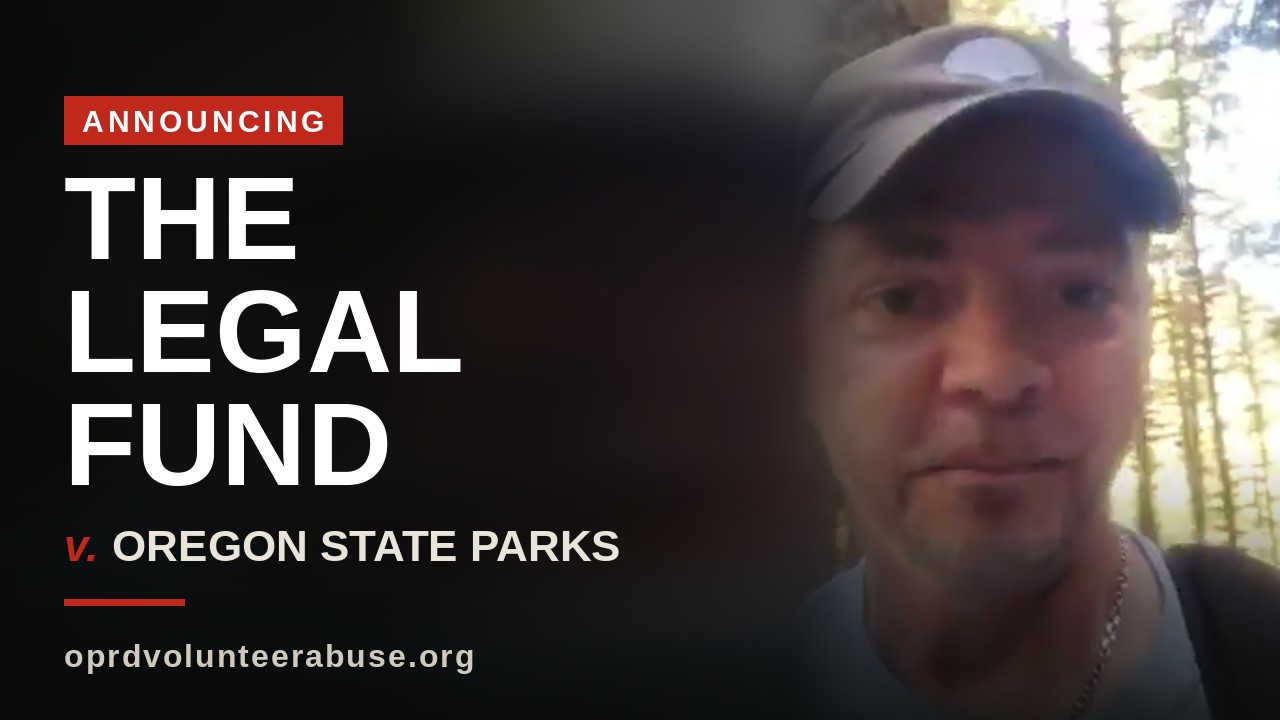
- I will reach out to relevant constitutional lawyers when the fund reaches $10,000.
- The $25,000 goal is an AI estimate; the right lawyer will give me the real number.
- This is a §1983 case against the institution. The only individual defendants are the director and her deputy.
- §1983 carries a fee-shifting statute (42 U.S.C. §1988): if the case prevails, the state pays the attorney’s fees.
- The Oregon State Police matters may be treated as a separate case; how that one is constructed, including whether officers are named individually, is for the lawyers to decide.
- Funds go to two things only: the retained lawyer, and technical costs of the case such as public records fees, internet and server costs, and archive infrastructure. Every dollar spent is accounted for publicly.
Does this project use AI?
I have been a programmer since the sixth grade. I have used machines my whole life. AI is no different.
I always have, from the very first message I sent inquiring about volunteer opportunities.
Every document an institution sends me is pulled out of my mailbox, rendered, indexed, and published at a permanent address that does not move. 536 documents so far.
279 numbered paragraphs drawn from 145 recordings and 96 documents, carrying 1,406 cited moments a reader can open.
Fourteen primary signals held as one cluster and read across six analytical lenses, instead of one file at a time.
It reads the institutions’ own productions first, cites the source at every claim, and renders a PDF in which every citation is a live link. Every letter goes out over my name.
From my commands: the pages, the ingest pipeline, and the gate that refuses to publish a record with a broken link in it.
What it is forbidden to do.
No defenses. It does not argue that I am credible or that I am right. The record shows what it shows.
No institutional framing. An institution’s account of its own conduct is never repeated here as though it were an event.
No case citations. It is not a lawyer, and my letters are not dressed as legal filings. A statute has a number. A case is an argument about the law.
No invented interior. It does not write what I felt, what I meant, or what I hoped for.
No unread source. It does not describe a document it has not opened. A title is not evidence of what is inside it.
No inexact quotation. Quoted words are the words in the source at the place cited, or they are not quoted.
I extend this to them too.
No characterizations. It does not write what they intended, meant, or felt. What they did and what they wrote is the whole of it.
No selective quotes. Nothing is clipped to make a person look worse than their full passage does. What they wrote is what appears.
No speculation about motive. Where the record does not say why someone acted, it stays silent on why.
No verdict language. It does not grade their conduct. It states what they did and lets that stand.
No withheld name published. The names I have chosen to redact stay redacted, in every document and every letter.
These are my ethics, written down. A state agency pointed the police at this archive looking for a pretext. The discipline above is why they did not find one.
The whole record, read as one.
Every primary recording this archive cites lives permanently on Autonomy Realms as an analyzed signal. The record is held there as one cluster, and the platform reads the whole cluster across six lenses. Each reading below opens that lens on the live record. The readings are machine analysis; the recordings and documents they read are the record.